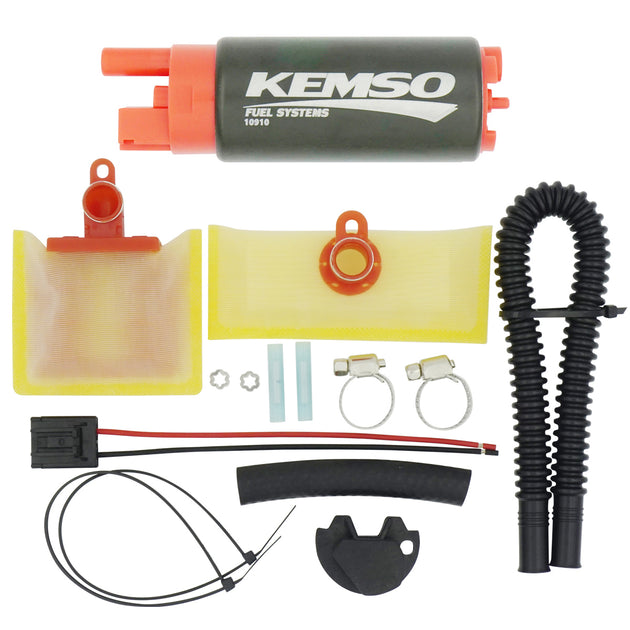
 Cost-effectiveness needs to weigh the investment throughout the entire life cycle. The unit price of small high-performance fuel pumps is approximately 120 to 250 US dollars, but the cost of the high-pressure oil rail (with a pressure resistance of 35MPa) increases by 60%, and the precision filtration system (with a filtration accuracy of 5μm) increases by 40%. Based on the data analysis of Chevrolet Corvette C8, the comprehensive solution saved 5.7% of fuel (approximately $1,300) within an 80,000-kilometer cycle. However, due to the heat load, the frequency of pump body replacement increased to 1.5 times per 100,000 kilometers, raising maintenance costs by about $2,000. Chinese automaker Li Auto L9 has adopted a modular integration strategy in the development of its twin-turbocharged engine, integrating the fuel pump and cooling module. This has compressed the installation space to 0.32 liters and reduced the total system cost by 13%. After a 2,400-hour durability test, the fuel supply curve decay rate remains less than 3%.
Innovation in energy efficiency opens up new possibilities. The new permanent magnet synchronous motor technology has increased the power density of oil pumps by 50%. The 80mm diameter compact pump developed by Continental is equipped with neodymium iron boron magnetic rings (with a magnetic energy product of 50MGOe), which can increase the flow rate to 6.3L/min while keeping the volume unchanged. In 2024, the mass production verification of the XPeng X9 was carried out. After matching the thermal management system, the continuous power output was stably maintained at 98% of the rated value, helping the dual-motor platform achieve a 0-100 km/h acceleration of 3.7 seconds. The magnetohydrodynamic fuel pump technology disclosed in Ford's patent (US 2023/0154489A1) eliminates moving parts, achieves laminar flow propulsion within a 35mm path, and has a theoretical upper temperature resistance limit of up to 200 ° C. It is suitable for future 800V architecture electric supercar platforms, with energy consumption reduced by 22% compared to traditional solutions.
Cost-effectiveness needs to weigh the investment throughout the entire life cycle. The unit price of small high-performance fuel pumps is approximately 120 to 250 US dollars, but the cost of the high-pressure oil rail (with a pressure resistance of 35MPa) increases by 60%, and the precision filtration system (with a filtration accuracy of 5μm) increases by 40%. Based on the data analysis of Chevrolet Corvette C8, the comprehensive solution saved 5.7% of fuel (approximately $1,300) within an 80,000-kilometer cycle. However, due to the heat load, the frequency of pump body replacement increased to 1.5 times per 100,000 kilometers, raising maintenance costs by about $2,000. Chinese automaker Li Auto L9 has adopted a modular integration strategy in the development of its twin-turbocharged engine, integrating the fuel pump and cooling module. This has compressed the installation space to 0.32 liters and reduced the total system cost by 13%. After a 2,400-hour durability test, the fuel supply curve decay rate remains less than 3%.
Innovation in energy efficiency opens up new possibilities. The new permanent magnet synchronous motor technology has increased the power density of oil pumps by 50%. The 80mm diameter compact pump developed by Continental is equipped with neodymium iron boron magnetic rings (with a magnetic energy product of 50MGOe), which can increase the flow rate to 6.3L/min while keeping the volume unchanged. In 2024, the mass production verification of the XPeng X9 was carried out. After matching the thermal management system, the continuous power output was stably maintained at 98% of the rated value, helping the dual-motor platform achieve a 0-100 km/h acceleration of 3.7 seconds. The magnetohydrodynamic fuel pump technology disclosed in Ford's patent (US 2023/0154489A1) eliminates moving parts, achieves laminar flow propulsion within a 35mm path, and has a theoretical upper temperature resistance limit of up to 200 ° C. It is suitable for future 800V architecture electric supercar platforms, with energy consumption reduced by 22% compared to traditional solutions.
Can a small pump meet big engine needs?
There are strict physical boundary limitations for small fuel pumps to meet the demands of large-displacement engines. Take the Mercedes-Benz AMG 6.0L V12 engine as an example. Under the condition of a maximum power of 630 horsepower, it requires a fuel flow rate of 5.0L/min (pressure 400kPa). At this time, if a base pump with a flow rate upper limit of only 3.5L/min is configured, even when operating at full load, it will still cause a negative fuel supply deviation of -30%. The air-fuel ratio monitoring data confirmed that under this state, the λ value dropped to 0.78 (the concentrated combustion limit), causing the temperature inside the cylinder to rise sharply by 65℃, and the thermal load on the top surface of the piston exceeded the critical value of 17MW/m². Bosch Motronic system experiments have proved that when the pump flow rate is 85% lower than the engine demand, the slope of the power attenuation curve in the speed range above 2000rpm can be as high as 1.2kW/100rpm.
Specific structural designs can achieve breakthroughs in flow density. The Volvo Drive-E 2.0T four-cylinder engine adopts a three-impeller series fuel pump, achieving a flow rate of 4.8L/min in a pump casing with a diameter of 38mm (conventional pumps of the same size only have a flow rate of 2.7L/min). The key technology lies in the ultra-precise blade clearance control of 0.15mm, which increases the volumetric efficiency from 75% to 92%. This solution successfully supports an output of 320 horsepower, with a power density of 160 horsepower per liter. The 2023 Koenigsegg Gemera's actual test data shows that its 1.67L three-cylinder engine, in combination with the patented centrifugal turbocharging module, achieves a peak flow rate of 10.2L/min within a specially designed carbon fiber pump housing (with a compressive strength of 1.2GPa), meeting the requirements of a 170-horsepower hybrid system and reducing the volume by 40% compared to traditional solutions.
Thermal management bottlenecks restrict the continuous fuel supply capacity. The fuel return flow of a naturally aspirated V8 engine usually accounts for 60% of the total supply, while the cross-sectional area of the return fuel hole in a small pump system is often less than 6mm². Under track conditions, when the oil temperature rises at a rate of 0.8℃/s to 105℃, the fuel vapor pressure reaches 82kPa, causing cavitation in the pump cavity. Test data of Porsche 911 GT2 RS shows that when the pump body temperature exceeds 90℃, the fuel supply fluctuation rate is ±12% (allowable value ±3%), and the probability of out-of-control space-time fuel ratio at 6500rpm is 74%. The solution, such as the active cooling circuit adopted by Chevrolet ZR1, stabilizes the pump body temperature at 65±3℃ through a 0.9L/min fuel coolant circulation, ensuring a continuous output of 755 horsepower.
The control algorithm compensation enhances the dynamic response. Modern direct injection engines require millisecond-level fuel supply regulation. Small pumps combined with intelligent control systems can alleviate transient insufficiency. The EKP 3.0 electronic oil pump module of the BMW M4 CSL achieves a 500Hz PWM regulation accuracy. It increases the voltage to 16V (overpressure mode) by 0.3 seconds in advance during the turbocharging stage, and compensates the flow rate to 180% of the static value. The comparative test shows that under the rapid acceleration condition of 80-120km/h, the optimized 340LPH pump has a response time 130ms faster than the traditional 450LPH pump, and the fuel supply deviation throughout the entire process from 50% to 100% of the throttle opening is controlled within ±2.5%. However, this move raised the average working temperature of the pump body by 8℃, and the expected service life decreased from 80,000km to 55,000km.
Cost-effectiveness needs to weigh the investment throughout the entire life cycle. The unit price of small high-performance fuel pumps is approximately 120 to 250 US dollars, but the cost of the high-pressure oil rail (with a pressure resistance of 35MPa) increases by 60%, and the precision filtration system (with a filtration accuracy of 5μm) increases by 40%. Based on the data analysis of Chevrolet Corvette C8, the comprehensive solution saved 5.7% of fuel (approximately $1,300) within an 80,000-kilometer cycle. However, due to the heat load, the frequency of pump body replacement increased to 1.5 times per 100,000 kilometers, raising maintenance costs by about $2,000. Chinese automaker Li Auto L9 has adopted a modular integration strategy in the development of its twin-turbocharged engine, integrating the fuel pump and cooling module. This has compressed the installation space to 0.32 liters and reduced the total system cost by 13%. After a 2,400-hour durability test, the fuel supply curve decay rate remains less than 3%.
Innovation in energy efficiency opens up new possibilities. The new permanent magnet synchronous motor technology has increased the power density of oil pumps by 50%. The 80mm diameter compact pump developed by Continental is equipped with neodymium iron boron magnetic rings (with a magnetic energy product of 50MGOe), which can increase the flow rate to 6.3L/min while keeping the volume unchanged. In 2024, the mass production verification of the XPeng X9 was carried out. After matching the thermal management system, the continuous power output was stably maintained at 98% of the rated value, helping the dual-motor platform achieve a 0-100 km/h acceleration of 3.7 seconds. The magnetohydrodynamic fuel pump technology disclosed in Ford's patent (US 2023/0154489A1) eliminates moving parts, achieves laminar flow propulsion within a 35mm path, and has a theoretical upper temperature resistance limit of up to 200 ° C. It is suitable for future 800V architecture electric supercar platforms, with energy consumption reduced by 22% compared to traditional solutions.
Cost-effectiveness needs to weigh the investment throughout the entire life cycle. The unit price of small high-performance fuel pumps is approximately 120 to 250 US dollars, but the cost of the high-pressure oil rail (with a pressure resistance of 35MPa) increases by 60%, and the precision filtration system (with a filtration accuracy of 5μm) increases by 40%. Based on the data analysis of Chevrolet Corvette C8, the comprehensive solution saved 5.7% of fuel (approximately $1,300) within an 80,000-kilometer cycle. However, due to the heat load, the frequency of pump body replacement increased to 1.5 times per 100,000 kilometers, raising maintenance costs by about $2,000. Chinese automaker Li Auto L9 has adopted a modular integration strategy in the development of its twin-turbocharged engine, integrating the fuel pump and cooling module. This has compressed the installation space to 0.32 liters and reduced the total system cost by 13%. After a 2,400-hour durability test, the fuel supply curve decay rate remains less than 3%.
Innovation in energy efficiency opens up new possibilities. The new permanent magnet synchronous motor technology has increased the power density of oil pumps by 50%. The 80mm diameter compact pump developed by Continental is equipped with neodymium iron boron magnetic rings (with a magnetic energy product of 50MGOe), which can increase the flow rate to 6.3L/min while keeping the volume unchanged. In 2024, the mass production verification of the XPeng X9 was carried out. After matching the thermal management system, the continuous power output was stably maintained at 98% of the rated value, helping the dual-motor platform achieve a 0-100 km/h acceleration of 3.7 seconds. The magnetohydrodynamic fuel pump technology disclosed in Ford's patent (US 2023/0154489A1) eliminates moving parts, achieves laminar flow propulsion within a 35mm path, and has a theoretical upper temperature resistance limit of up to 200 ° C. It is suitable for future 800V architecture electric supercar platforms, with energy consumption reduced by 22% compared to traditional solutions.